World Wind Java SDK Web Site
All you want to know about the World Wind Java SDK is here:
http://goworldwind.org/
Photographie, Stéréoscopie, Science, 3D, NASA World Wind
All you want to know about the World Wind Java SDK is here:
http://goworldwind.org/
Posted by
Patrick Murris
at
16:26
2
comment(s)
Permalink
Key words 3D, Open Source, World Wind
From the WWJ SDK Developement team:
"On Tuesday July 19th, 2011 we are releasing World Wind 1.2. Please join us that day for the webinar, where we'll describe the release contents and the new resources available to help and guide World Wind developers. We'll also discuss World Wind's near-term road map. There are sessions for American and European time zones, There are only 100 spaces available per session, so sign up soon, but please don't sign up if you are unlikely to attend.
Register for a session now by clicking a date below:
Tue, Jul 19, 2011 4:00 PM - 4:45 PM CEST
Tue, Jul 19, 2011 10:00 AM - 10:45 AM PDT
Once registered you will receive an email confirming your registration with information you need to join the Webinar."
Posted by
Patrick Murris
at
06:42
2
comment(s)
Permalink
Key words 3D, Open Source, World Wind
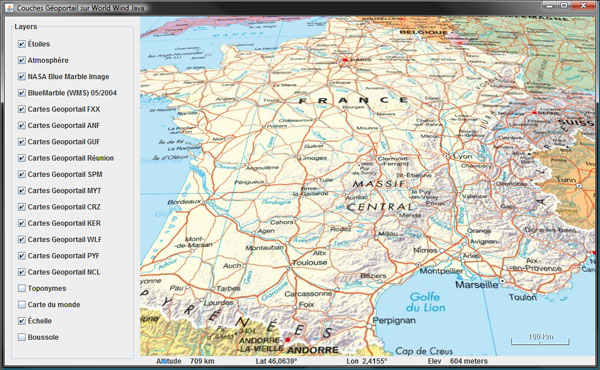
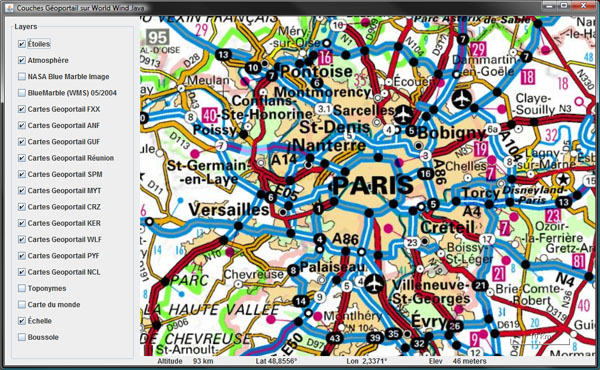
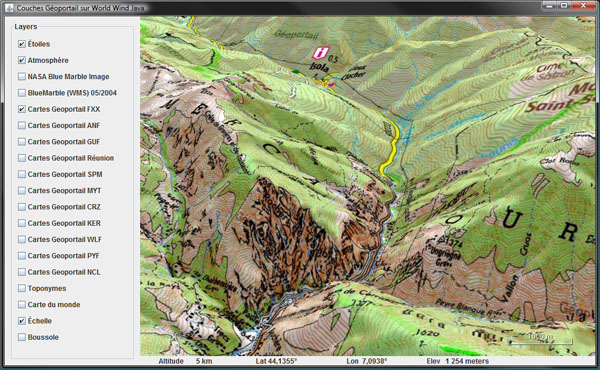
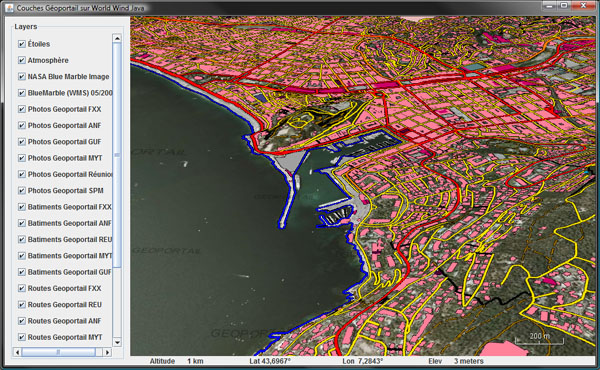
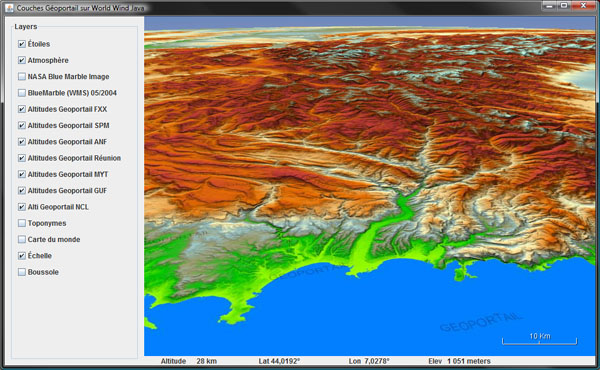
Nice surprise today, the French Geoportail is publishing it's layers content via a new World Wind Java application available online.
Some screenshots:
France map
Paris area
Topo maps over Mercantour National Park
Roads, shoreline and buildings over aerial imagery
Colored DTMs - French Riviera and the Alps
Posted by
Patrick Murris
at
17:20
4
comment(s)
Permalink
Key words 3D, France, Open Source, World Wind
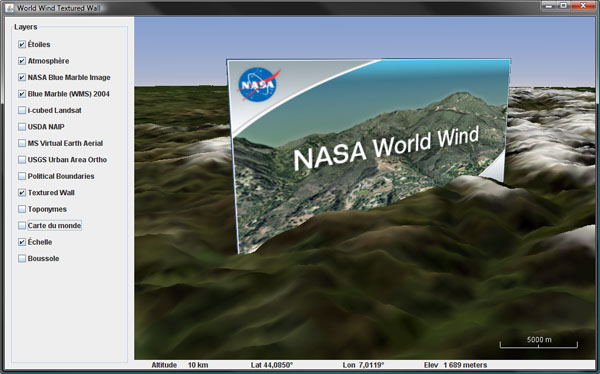
Following up on a WWJ Forum post regarding a 'vertical image' to display atmospheric data, i quickly put together a simple renderable that will draw an image on a plane perpendicular to the globe surface.
Download TexturedWall.java - remove the .txt extension and save in the SDK render package.
Nothing fancy, really, a texture rendered over a quad - it will not 'curve' around the globe on long distances. The quad is defined with two LatLon locations, a bottom and a top altitude. It is also an example of a simple renderable using OGL primitives that may serve as a base template for more sophisticated objects.
Posted by
Patrick Murris
at
20:07
10
comment(s)
Permalink
Key words 3D, Open Source, World Wind
Happy 2010 to you all! - and plenty of virtual globes!
Sorry for posting so little lately... the World Wind Java SDK is keeping the team very busy. I also lost my father last summer.
I should certainly post a review of what has changed in the WWJ SDK since the nightly builds and 0.6 have been made available (was it last March?!) and i'm hopping to do that soon.
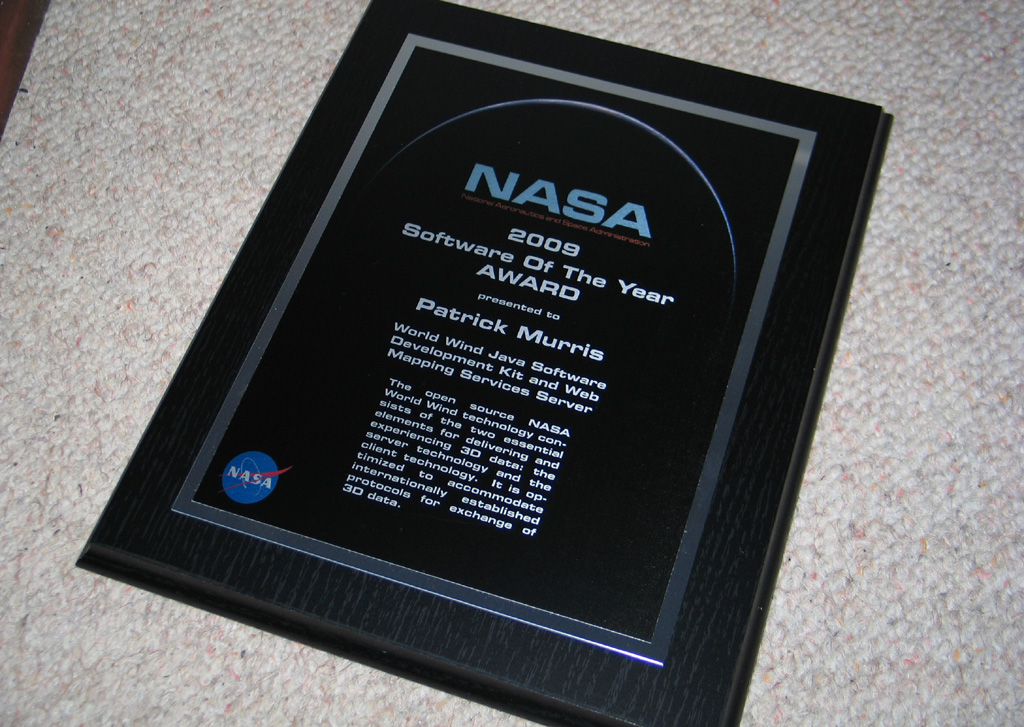
In the mean time i'm proud to show you the beautiful plaque i received from NASA, almost for Christmas. It is surprisingly heavy!
Posted by
Patrick Murris
at
19:45
2
comment(s)
Permalink
Key words 3D, Open Source, World Wind
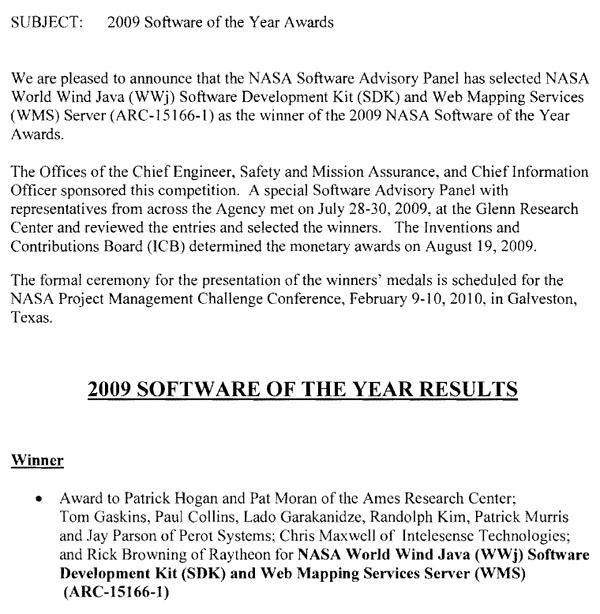
The NASA Software Advisory Panel has selected the World Wind Java SDK for the 2009 NASA Software Of The Year Award.
See this World Wind Forum post for the announcement by Project Manager Patrick Hogan at Ames Research Center.
This is great news for the free and open source project which will certainly receive increased attention from the other departments of the space agency - and beyond. World Wind was initiated by NASA Learning Technologies in 2002.
Posted by
Patrick Murris
at
21:07
3
comment(s)
Permalink
Key words 3D, Open Source, World Wind
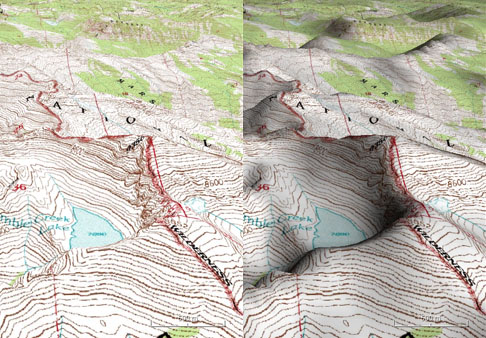
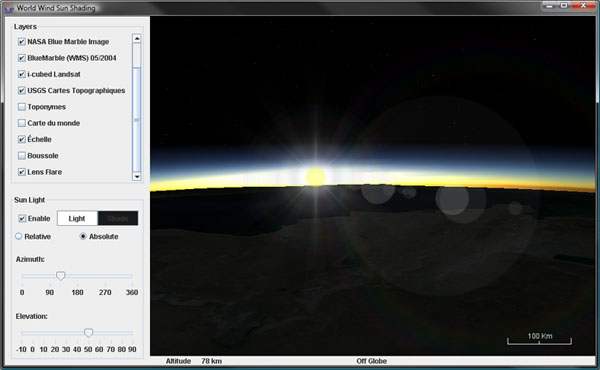
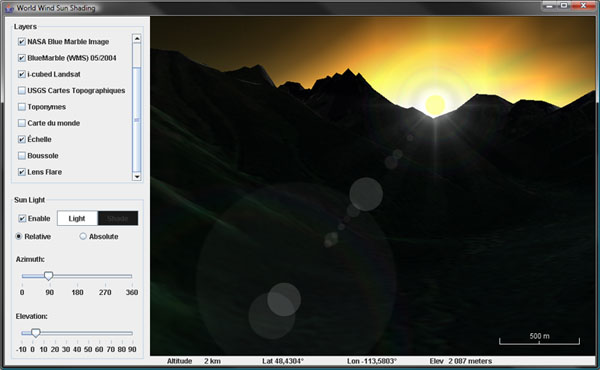
Here is the very first iteration of a sun light package for NASA WorldWind Java. It includes a custom tessellator for terrain shading, an atmospheric scattering based sky layer, a sun position calculator and a lens flare effect. Some of the code has been contributed by WWJ Forum member Michael de Hoog aka Omega.
Terrain shading
Lens flare and atmospheric scattering
Sun occlusion
Posted by
Patrick Murris
at
16:50
9
comment(s)
Permalink
Key words 3D, Open Source, World Wind
Access to the daily NASA WorldWind Java SDK 0.6 source code has been made public from the NASA WWJ build site. You will find the announcement and change list in this WWJ Forum post.
So much has been going into the SDK since the 0.5 release in May 2008 it is hard to sort out what the most notable changes and additions are. Here are a number of new features that come to mind.
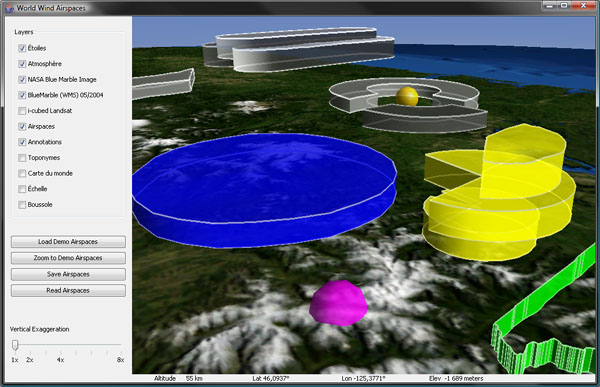
Airspace volumes
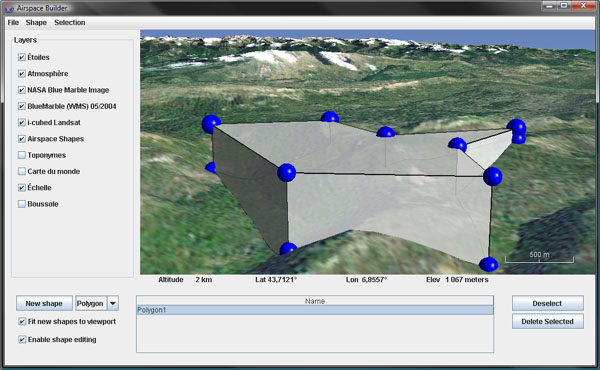
Airspace builder
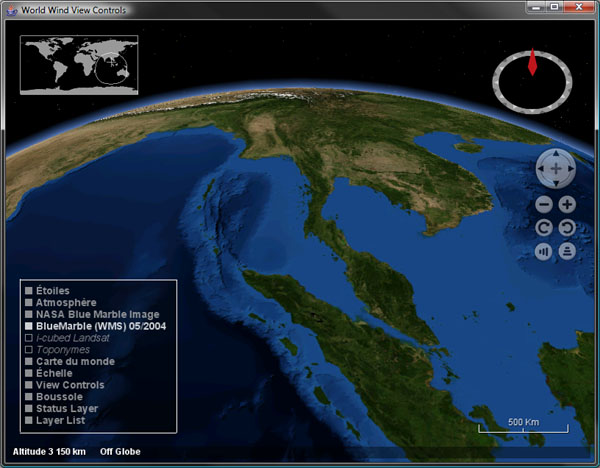
On-screen layer manager, status bar and view controls
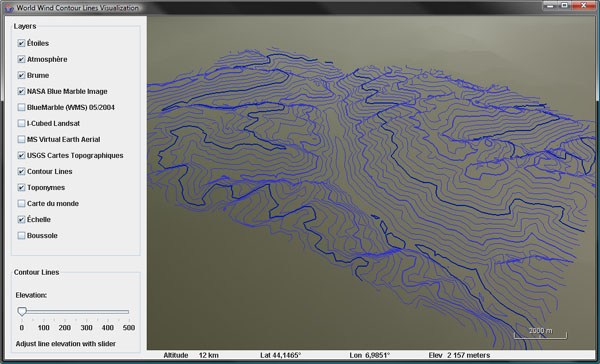
Contour lines
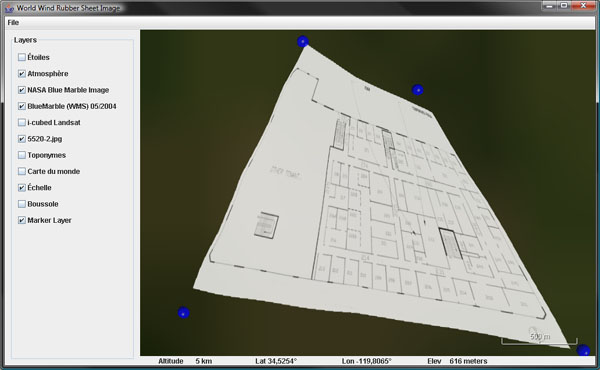
Rubber sheet images
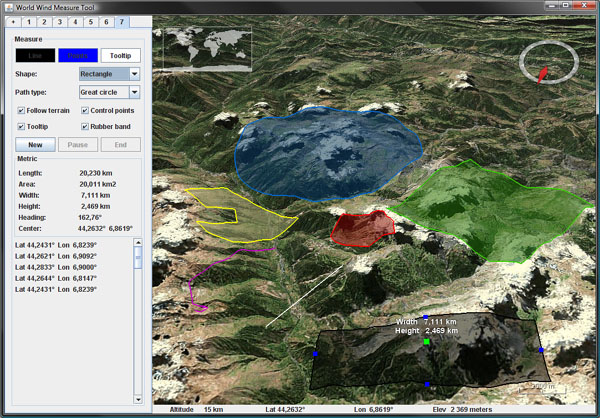
Length and area measure tools
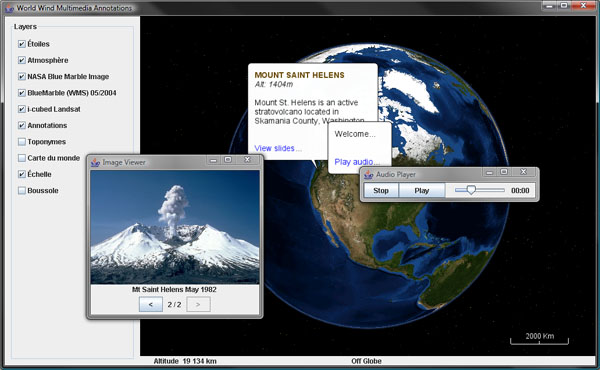
Multimedia annotations
Posted by
Patrick Murris
at
18:08
7
comment(s)
Permalink
Key words 3D, Open Source, World Wind
Patrick Hogan is NASA World Wind Project Manager. He was kind enough to answer and comment ten questions regarding NASA virtual globe project and open source initiative.
1. World Wind came out in 2004 before Google Earth and is arguably one of the (if not the) first virtual globe. What is the 'short' history of World Wind - how and when did it all start, what where the goals and the context?
World Wind began in the 2002/2003 timeframe under NASA Learning Technologies, a program to get 'NASA content' into the classroom. In January 2004 World Wind became one of the first NASA programs to be released as open source. World Wind existed approximately coincident with Keyhole, though neither knew of each other until later.
2. World Wind is a free and open source project delivering technologies to the community that some private companies have spent large amounts of money to acquire. Who is paying for this and how come it’s given away just like that?
Same answer as to your previous question, World Wind began as part of NASA Learning Technologies, a program to get 'NASA content' into the classroom. NASA has more planetary information than any other entity on Earth. NASA, more than any other entity on Earth, needs to have the tools necessary to work with planetary data that is part of the public domain. Today, more than ever, it is vital that research, academia and the public have useful access to this data. This is made most possible with technology that can readily adapt to service those various needs. This includes the need for a broad spectrum of private companies who are free to use this technology in proprietary ways. World Wind open source technology stimulates entrepreneurial enterprise by helping to standardize the geospatial information exchange medium. This establishes the infrastructure for greater participation by the widest possible range of business enterprise from small to large.
The World Wind project is supported by several agencies within the US federal government, including of course NASA.
By using open source technology and open standards for data exchange, the government has the ability to adapt to rapidly changing circumstances. Building increasingly more sophisticated functionalities to a core technology that is open source continually challenges entrepreneurs and the world community to greater appreciation for what is possible. NASA provides the kind of leadership that allows for this. World Wind technology also provides the government with absolute control over use of the technology, as well as absolute security due to code visibility, while also making industry and the world community more competitive in the area of solutions based on use of this open and standardized technology. These solutions can be proprietary, free, or open. Advances in intelligence come from a combination of information access and increasingly sophisticated processing of that information. World Wind, although a very smart mechanism, is not intelligence. World Wind technology is about standardized and optimized delivery of pixels, picking them up and moving them around. Information intelligence is applied by others using this technology as the medium for information exchange, a lingua franca, if you will.
3. A common reaction to the World Wind project is to wonder why bother redeveloping something that already exist for free, namely Google Earth or Microsoft’s Virtual Earth?
Google, who bought Keyhole in October of 2004, delivers data that is proprietary and restricts use of its technology essentially to the KML file format. World Wind provides that same ability without any limitation on how one might use the technology. This stimulates business opportunities for a much larger solution domain.
4. It is a bit disappointing that one cannot access imagery as good as in other virtual globes with NASA software. Why is it so?
When you open World Wind, out of the box so to speak, it arrives with the base set of data needed for a 3D world. Although higher quality imagery is available that World Wind can certainly deliver, and does so for those who have access to that data, the base set of data that World Wind comes with is necessarily in the public domain. We are looking forward to higher quality imagery becoming increasingly more available. We are already seeing this happen. The great State of New York and the great country of New Zealand, having made higher quality imagery publicly available, prove this is already happening.
5. There does not seem to be any 'road map' for the World Wind Java SDK. How are decisions made regarding the implemented capabilities?
For those who can appreciate the degree of sophistication involved in developing an Application Programming Interface (API) -centric Software Development Kit (SDK), it’s easy to understand the unusual amount of *accommodation* required for how others will use the technology. Building an optimized and adaptable technology of this nature is a Herculean task. It is far more involved than simply building an application. World Wind technology must transparently 'plug-in' to other applications. The ability to do that well is as much art as engineering. Leonardo da Vinci was notorious for spending inordinate amounts of time working through ideas before ever putting paint to brush. World Wind is being crafted as an adaptable building block others construct with. Making it work requires accounting for many variables well beyond our control. Building for the future is an infinite challenge. We look forward to a time when much more of the world participates in the development. Although this is already happening informally, this will begin in earnest with release of v1.0.
6. How large is the development team?
I’ve heard it said that it’s not size that matters. So thankfully, we have a few of the best. At some point, after version 1.0, we’d like to see a collaboration of the world community to advance this core technology. We’re already seeing this technology applied by the European Space Agency, the Japan Space Agency, and a few Fortune 100 companies, as well as extensively within the US government.
7. A number of community users would be willing to contribute code to the project but there is no such established process to do so now. Are there any plans to allow contributions?
We welcome contributions and have already put some of those to good use. We want World Wind development in the hands of a well organized worldwide consortium. That takes a concerted effort by the world community. We look forward with great anticipation to that stage of this project. You don't have to be a rocket scientist to know that the amount of energy required to effectively process the input from a worldwide community is enormous. 2009 should be 'the' year for version 1.0 of World Wind along with the hope for a world community that hosts the ongoing development of this technology.
8. The WWJ SDK is still in alpha stage after two years. When can we expect a stable 1.0 release and what will be in it?
In the spirit of ‘we will serve no wine before its time,' version 1.0 is expected during the second half of this year (2009). What will be in it? More and better stuff!
9. The WWJ SDK departed from the World Wind .NET version in the sense it is not a 'ready to use' client application one can download and use right away. Although there are clear advantages in providing a SDK, are there any plans to produce a WWJ client application similar to the .NET version so many have been using?
World Wind Java is component technology purposed to be used as a plug-in by others in support of their visualization needs. We like playing a strong supporting role rather than the lead. We believe this provides the maximum opportunity for information exchange technology to advance.
10. The unique aspect of World Wind technology is that it also provides the WMS server software to deliver geospatial data. How did that happen?
World Wind SDK technology is there to visualize geospatial data, manage the pixels so to speak. Having the technology to see 3D is cool, but that's only half the story, maybe even the smaller half. Making data accessible, the data delivery mechanism, is where the information experience begins. The World Wind Server delivers data according to the Open Geospatial Consortium international WMS standards.
Together, the World Wind SDK client and WMS server provide the infrastructure for government, research, and business communities, as well as education and public outreach, to both deliver and experience information, hopefully increasing our understanding. And it is also true that sometimes we do things just for fun! World Wind technology unlocks the power to make all this happen.
Patrick Hogan - interview by Patrick Murris, January 2009.
Photo from swissstartups.com.
> Another Patrick Hogan interview by Scott Swigart, and Sean Campbell for the How Software is Built blog - July 2007.
> World Wind presentation at the Geological Society of America, May 2007. How the Java SDK got started.
Posted by
Patrick Murris
at
18:24
2
comment(s)
Permalink
Key words 3D, Open Source, World Wind
Patrick Hogan the NASA World Wind project manager will be presenting the World Wind Java SDK at the 2008 American Geophysical Union Fall Meeting in San Francisco December 15-19.
Although Google Earth and KML have an overwhelming presence, the World Wind Java SDK is being used by an increasing number of professionals:

Posted by
Patrick Murris
at
21:44
0
comment(s)
Permalink
Key words 3D, Open Source, World Wind